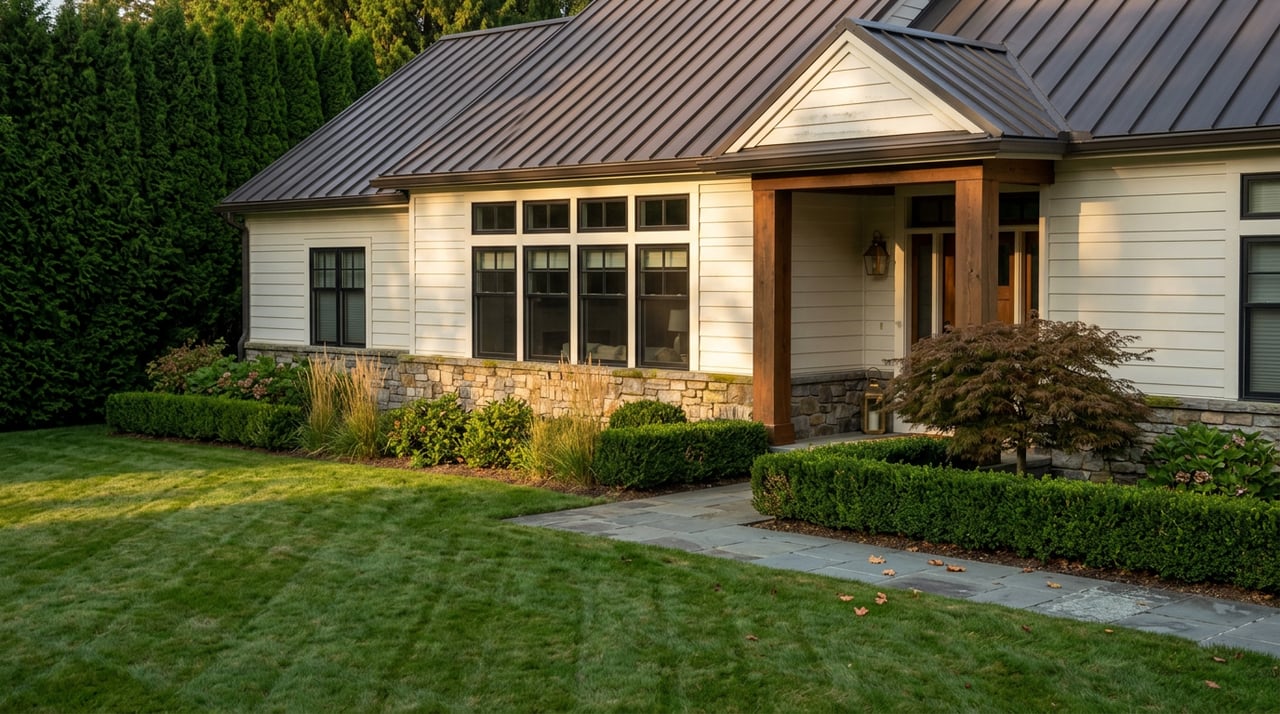
Clyde Hill's Median Price Is the Wrong Number to Watch in 2026
September 24, 2026
September 24, 2026
Two houses on the same street tell you more about Clyde Hill in 2026 than any median price will. A property on NE 32nd Street has come back onto the market more than once this year, each time at a lower number than the last. A house on NE 28th has done the same. Neither is a distressed sale. Both are ordinary listings that started at a price the seller believed the neighborhood would support, then found out otherwise, in public, over several months.
That pattern, repeated across a handful of addresses, is a better read on Clyde Hill right now than the headline median price, because Clyde Hill barely produces enough closings in a given month to calculate a median that means anything. This is a market where the story isn't the number. It's what happens between listing and closing, and in 2026 that gap has widened in a way worth understanding before you price a home here or use someone else's median to judge whether now is the right time to sell.
Clyde Hill is one of the smallest housing markets on the Eastside by transaction count. In a typical month, the city sees single-digit closings. As of a market snapshot taken in July 2026, the city had 20 homes on the market with a median asking price of $6,204,000, but only five homes had closed the prior month and four had closed in the preceding 30 days. Months of residential supply sat at 9.09, a level that generally signals a buyer's market with downward pressure on pricing.
That's the setup. Here's the friction: the median price of homes that actually closed in June 2026 was $4,000,000, down 12 percent from the same month a year earlier. Look at the trailing six months instead and the median closed price climbs to $5,700,000. Three numbers, three different stories, all technically true, all describing the same small city in the same year.
None of that is a data error. It's what happens when a handful of closings, sometimes as few as two or five in a given month, get treated as if they were a statistically stable sample. A single $13 million sale or a single $2 million sale can move the median by six figures overnight. When a national home-value estimator or a portal's monthly report tells you Clyde Hill prices are up, or down, by high single digits year over year, both can be correct and both can be describing noise rather than trend.
The more useful number sits between those two figures: the gap between what sellers are asking and what buyers are actually paying. A $6.2 million median ask against a $4 million to $5.7 million median close, depending on the window, is not a rounding difference. It is the visible residue of sellers testing a price the current market won't confirm.
That gap shows up most clearly in the sale-to-original-list-price ratio, which has slipped to roughly 93.5 percent this year. A seller who lists at $10 million and eventually closes at $9.35 million isn't unusual anymore. A seller who lists at $17 million and closes at $13.5 million, as happened with one Clyde Hill estate on NE 14th Street after 178 days on market, is an extreme version of the same pattern: the market found a number the seller hadn't initially been willing to accept.
None of this means Clyde Hill is losing value as a place to live. It means the era of naming a price based on reputation and watching buyers meet it without negotiation is over for the moment. The neighborhood's appeal, its Lake Washington views, its privacy, its walk to nowhere and drive to everywhere, hasn't changed. What's changed is how much patience buyers extend to a seller's opening number.
The clearest evidence of that shift is in how differently two pricing strategies are performing this year.
| Priced to recent closed comps | Priced above recent closed comps | |
|---|---|---|
| Typical days on market, 2026 | Around 21 days | Around 58 days, up from about 35 in 2025 |
| What happens next | Some close in five days or less, occasionally above asking | Repeated price cuts, some relist under a new MLS number, some withdraw |
| Where it shows up | Six Clyde Hill properties closed in five days or less this year | Addresses like NE 32nd and NE 28th cycling through multiple listing attempts |
The homes that price to what recently closed, not to what a neighbor hoped to get, are moving in three weeks. The homes that open above that line are sitting for two months or longer, and a meaningful share of them cancel and come back rather than close. Cancellations across Clyde Hill are on pace to roughly triple in 2026 compared with 2025, from 14 for the full prior year to 25 in the first half of this year alone. That's not a market falling apart. It's a market getting less forgiving of a specific mistake.
While the public listings absorb that friction, a smaller and quieter track is producing a very different outcome. Seven Clyde Hill homes have sold off-market so far in 2026, averaging $5.45 million, and closing at 100 percent of asking price. No relists, no price cuts, no public days-on-market clock running against the seller.
That's not evidence the public market is broken. It's evidence that a home priced correctly from the start, and marketed to the right buyer before it ever needs a public price adjustment, skips the part of the process where reputations and headlines get made. For a seller weighing whether to test the market publicly or move quietly, that's the actual decision in front of them in 2026, not whether the median is up or down.
For a buyer weighing Clyde Hill against Medina or Hunts Point, or a seller trying to decide whether this is the year to list, the practical takeaway isn't a single number. It's a set of questions that get past the noise:
A buyer who only checks a portal's median before making an offer is negotiating against a number that may have been generated by two sales. A seller who prices to that same median without checking how it was calculated risks becoming the next relisted address on NE 32nd or NE 28th.
Why do different websites show such different price trends for Clyde Hill? Because Clyde Hill closes so few homes each month, one or two unusually high or low sales can swing a monthly average or median by a large percentage. Different sites also pull from different windows, monthly, quarterly, or trailing six months, so a genuinely accurate figure from one source can look like it contradicts an equally accurate figure from another.
Is Clyde Hill currently a buyer's market or a seller's market? The supply data points toward conditions favoring buyers, with months of supply above nine as of mid-2026. But the properties priced close to recent closed comps are still moving quickly and sometimes drawing multiple offers, which means the answer depends heavily on how a specific home is priced relative to what has actually closed nearby.
Does an off-market sale mean the seller got a worse price? Not based on the 2026 data. Off-market Clyde Hill sales this year have closed at full asking price on average, matching or outperforming what many publicly listed homes achieved after price reductions.
Clyde Hill's numbers this year reward the seller and the buyer willing to look past the headline and into the closings themselves. If you're trying to make sense of what a specific property or a specific address is actually worth in this market, that's a conversation worth having before a listing goes live, not after it's been relisted twice. Work With Lizanne to look at the real comparables behind the number.
Stay up to date on the latest real estate trends.
With an early career in design, marketing, and corporate partnerships at Seattle’s top firms, Lizanne brings a sharp, creative edge to residential real estate. She combines expert negotiation with data-driven marketing to deliver seamless results. Whether finding your dream home in Seattle or the Eastside's most coveted neighborhoods—or maximizing value for your property—Lizanne provides unparalleled service backed by Windermere, the region’s most trusted brokerage.
Let me know how I can assist you.